Finding a hidden water leak is stressful, but the next step, choosing the right company to find it, can feel overwhelming. You need an expert who will locate the leak accurately, minimise damage to your property, and provide a report that your insurance company will accept.
This guide provides a straightforward checklist for homeowners, landlords, and businesses across the UK. It cuts through the jargon and shows you the essential criteria you must verify before spending on a leak detection service. By the end of this article, you will know exactly what questions to ask to ensure you hire the best company for the job.
Skip to:
Authority and independence
Before you look at a company’s tools or prices, you must verify their credentials and operating model. Getting these steps right is critical for a smooth claims process.
Are they independent or insurer-recommended?
This is the most crucial question you can ask. Your insurer may try to direct you to their ‘approved’ contractor, but you have the legal right in the UK to choose your own independent specialist. An independent company works for you, not the insurer, ensuring their focus is on providing the most accurate, non-destructive service and an unbiased report. Choose a company that will protect your interests first.
Another great way to check for credibility is by taking a look at their reviews on platforms like Trustpilot and Google Reviews. Also, check their website for case studies to see what kind of water leak detection projects they’ve worked on previously. Here’s a couple of Ideal Response examples; ‘External cold mains water leak‘ and ‘Water ingress affecting the cellar‘.
Verify credentials, licensing, and insurance
A professional company must be fully regulated and insured. Look for evidence of:
- Public liability insurance: Essential protection in case of accidental damage.
- Industry accreditations: Look for recognition from bodies like WaterSafe or the Chartered Institute of Plumbing and Heating Engineering (CIPHE). These accreditations show a commitment to professional standards and ongoing training.
- Full-time specialists: Are you hiring a dedicated leak detection team, or a general plumber who occasionally uses a listening stick? Specialist knowledge is essential for complex, hidden leaks.
Technology and technique
A specialist company’s technology is the key differentiator in providing a non-destructive service. The best companies don’t rely on guesswork.
Do they guarantee non-destructive detection?
A core fear for any property owner is having floors ripped up or walls damaged only for the leak not to be found. A specialist should use non-invasive methods first. If a small, surgical break-in is necessary to confirm the source, it should be the final step, not the first.
What specialist tools do they use?
A reputable specialist should employ a suite of non-invasive tools, not just one. Ask them to confirm the use of the following for maximum accuracy:
- Thermal imaging: Cameras that detect subtle temperature differences caused by escaping hot (or cold) water, excellent for tracing central heating pipe routes.
- Acoustic detection: Highly sensitive ground microphones that listen for the unique sound waves of water escaping from a pressurised pipe.
- Tracer gas testing: Injecting a safe, non-toxic gas (typically a nitrogen/hydrogen mix) into the system that escapes through the leak, detected above the surface by highly sensitive sniffers.
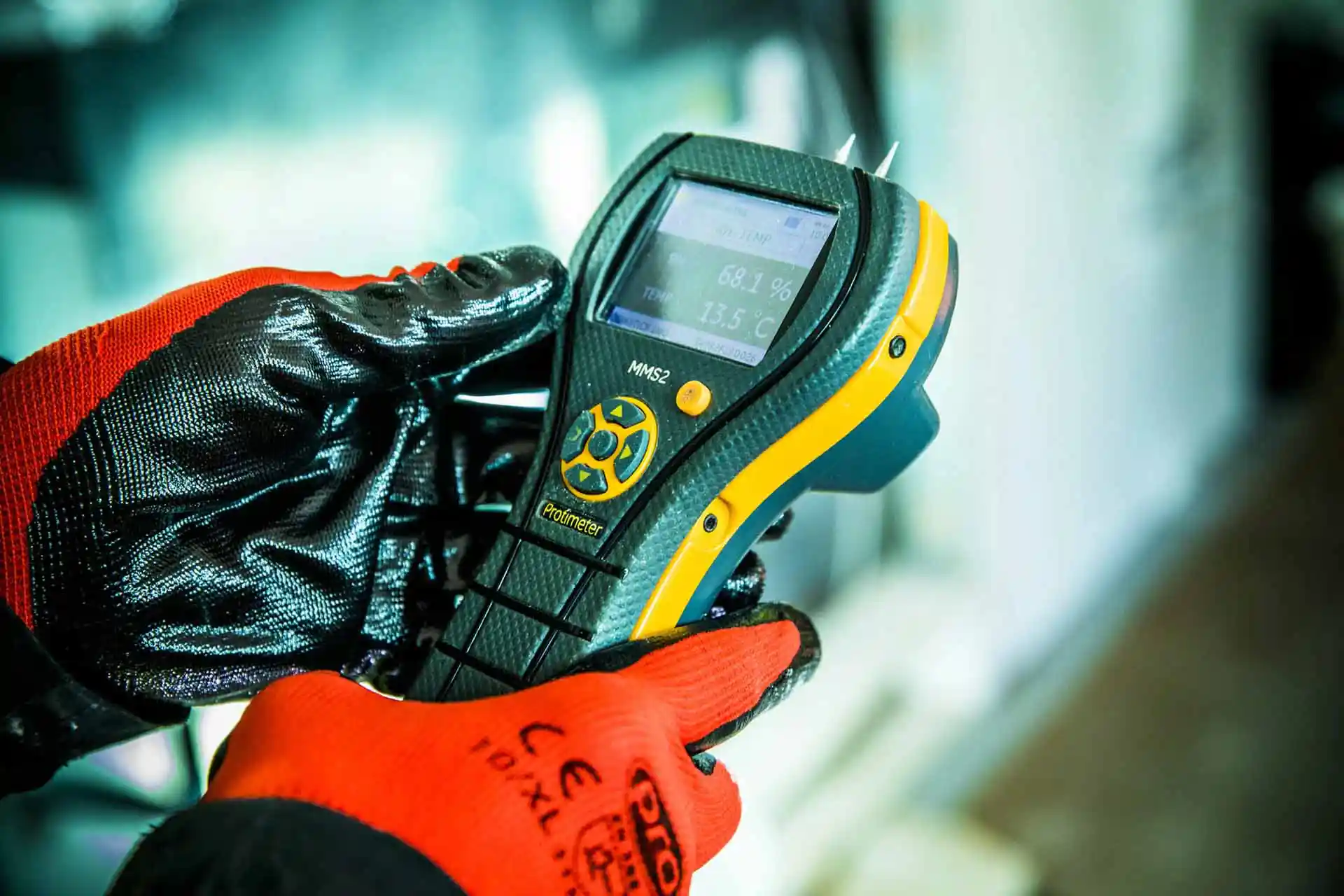
- Moisture mapping: Devices used to track the path of water damage back to its likely origin within walls and floors.
Commercial water leak detection: A specialist concern
For businesses, the stakes are significantly higher. In the UK, water leaks account for an estimated 50% of all commercial insurance claims, with potential losses averaging £1.4 million per incident, which vastly exceeds the average for residential properties.
Key differences for commercial properties
Commercial and industrial sites present unique challenges that demand a higher level of expertise:
- System complexity: Extensive, high-pressure networks (HVAC, fire suppression, process water).
- Pipe location: Buried deep under large car parks, in suspended ceilings, or utility trenches.
- Financial risk: Operational shutdown, stock loss, reputational damage, and major structural issues.
- Responsibility: Owner/occupier is responsible for all pipework within the property boundary, which can be extensive.
Focus on business continuity
When choosing a commercial leak detection company, ask these extra questions:
- Emergency response time: Can they offer a guaranteed out-of-hours or rapid response to minimise business downtime?
- Scale of equipment: Do they use industrial-grade correlators and Ground Penetrating Radar (GPR) capable of scanning deep beneath large commercial slabs and external areas?
- Reporting for loss adjusters: Do they have a proven track record of creating detailed reports that satisfy commercial loss adjusters and include estimates for business interruption?
The claim-ready report
Ensure the company provides a comprehensive report that is specifically formatted for your insurer and covers your ‘Trace and Access’ cover. This report must clearly document:
- The non-destructive methods used (Thermal, Acoustic, Gas).
- High-quality photographic evidence of the leak and the precise location.
- Confirmation that the leak was found and exposed, ready for the final repair.
Transparency in pricing and guarantees
A reputable company will offer a clear breakdown of costs. Be wary of vague estimates. Ask about:
- Upfront costs: Are all call-out charges, travel, and equipment fees included in the initial quote?
- ‘No find, no fee’ policy: While this sounds ideal, be careful of caveats. Ask exactly what is covered and what is excluded. A specialist confident in their non-destructive techniques should offer a guarantee of accuracy.
The right decision for you
Your choice of leak detection company is the most important decision you will make after discovering a leak. A hurried or poorly researched choice can lead to a rejected insurance claim, unnecessary damage to your property, and a higher overall repair bill.
By using this checklist, you move from a position of uncertainty to a position of informed authority. You are now equipped to choose a company that guarantees non-destructive accuracy, provides the documentation your insurer demands, and gets your property, domestic or commercial, back to normal quickly and efficiently.
Skip the search. Talk to a specialist today.
Ready to find and fix your water leak? Our accredited, insurance-approved UK leak detection engineers offer non-invasive leak detection and fast, expert support for your Trace & Access claim.
Need to speak to a specialist urgently? Call 0800 088 4170
FAQs for choosing the best leak detection company
Is leak detection covered by my UK home insurance?
Yes, in most cases. The cost of locating and exposing a hidden water leak is typically covered under a specific provision in your buildings insurance called ‘Trace and Access’ cover. This part of the policy pays for the costs incurred by the specialist to trace the leak and break into walls, floors, or concrete to access it for repair.
To learn more about leak detection and insurance cover, read ‘Does my home insurance cover water leak detection? A UK guide‘.
How much does a professional leak detection survey cost in the UK?
The cost for a professional, non-invasive leak detection survey typically ranges between £500 and £1,250 in the UK, depending on the complexity of the property and the leak location. However, if you have Trace and Access cover, this cost is usually fully reimbursable or paid directly by your insurer, subject to your policy’s limit and excess.
What is 'non-invasive' leak detection, and what tools should they use?
Non-invasive refers to techniques that allow specialists to pinpoint a leak without unnecessary damage or destruction. Reputable companies rely on advanced technology, including:
- Thermal imaging cameras: To detect slight temperature changes in surfaces caused by water.
- Acoustic listening equipment: To locate the sound of escaping water within pipes.
- Tracer gas testing: Introducing a harmless gas into the pipework and detecting where it escapes.
- Moisture meters: To map the extent of water ingress on surfaces.
If you’re curious about the technical side of leak detection, read How leak detection works: Tools and techniques explained.
Does 'Trace and Access' cover the actual repair of the damaged pipe?
No, this is a common misconception. Trace and Access cover only pays for the work required to find the leak and gain access to it (e.g. drilling through a concrete floor). The cost of the actual pipe repair itself and the subsequent costs of drying out and restoring the property damage (reinstatement) are covered under the main Escape of Water section of your buildings insurance policy.
What accreditations should a reputable UK leak detection company have?
Professional leak detection services use advanced, non-invasive technology to locate the source of a leak. Common methods include acoustic listening (using highly sensitive microphones to hear escaping water), thermal imaging (using cameras to detect temperature changes), and tracer gas (injecting a harmless gas that escapes at the leak point).
If you’re interested in the technical side of leak detection, learn more about the equipment used by reading How leak detection works: Tools and techniques explained.

Dave Knight - Leak Detection Technical Manager
With over 26 years' experience in property damage restoration, our Leak Detection Technical Manager is a seasoned expert. He brings a specialised focus of 21 years in leak detection and trace & access claims, including 10 years as the owner of a specialist leak detection company. He uses advanced, non-invasive technology to find leaks with minimal disruption in both domestic and commercial settings. His extensive water leak detection qualifications, including WRAS and BDMA, and his experience leading projects across the UK and Europe, highlight his expertise.