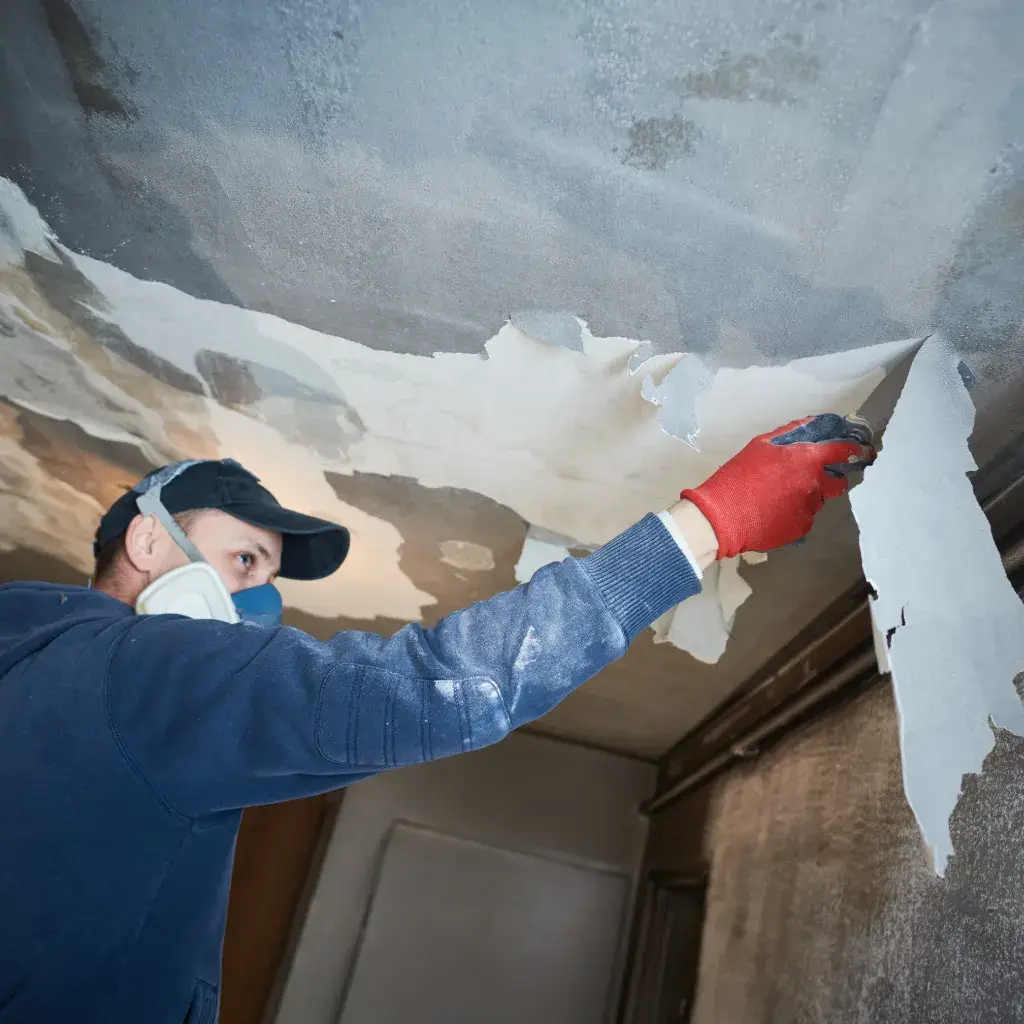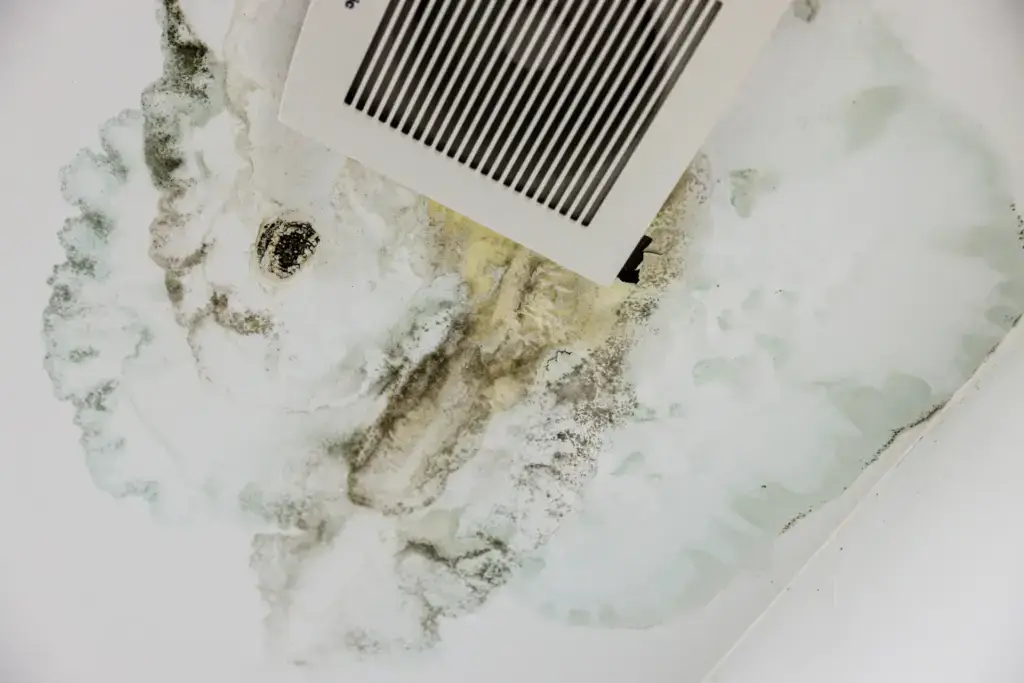
Thermal imaging cameras are able to identify temperature changes and display the difference. Water/ moisture is often cooler than your properties walls, allowing for accurate mapping of moisture. It is an essential tool damp surveying and pinpointing water ingress.
For many homeowners and property managers, damp is a recurring nightmare. You paint over a salt stain or scrub away mould, only for it to return weeks later. The reason most treatments fail is simple: the source of the moisture was never accurately identified.
In the past, damp surveys relied on visual guesswork. Today, a professional damp survey that combines technical readings, a thermal imaging survey and moisture mapping allows us to see through the building’s fabric. Identifying the root cause of damp, whether it’s rising from the ground, penetrating through the masonry, or caused by elevated moisture levels in the air.
Skip to:
Thermal bridging & condensation
How does thermal imaging work?
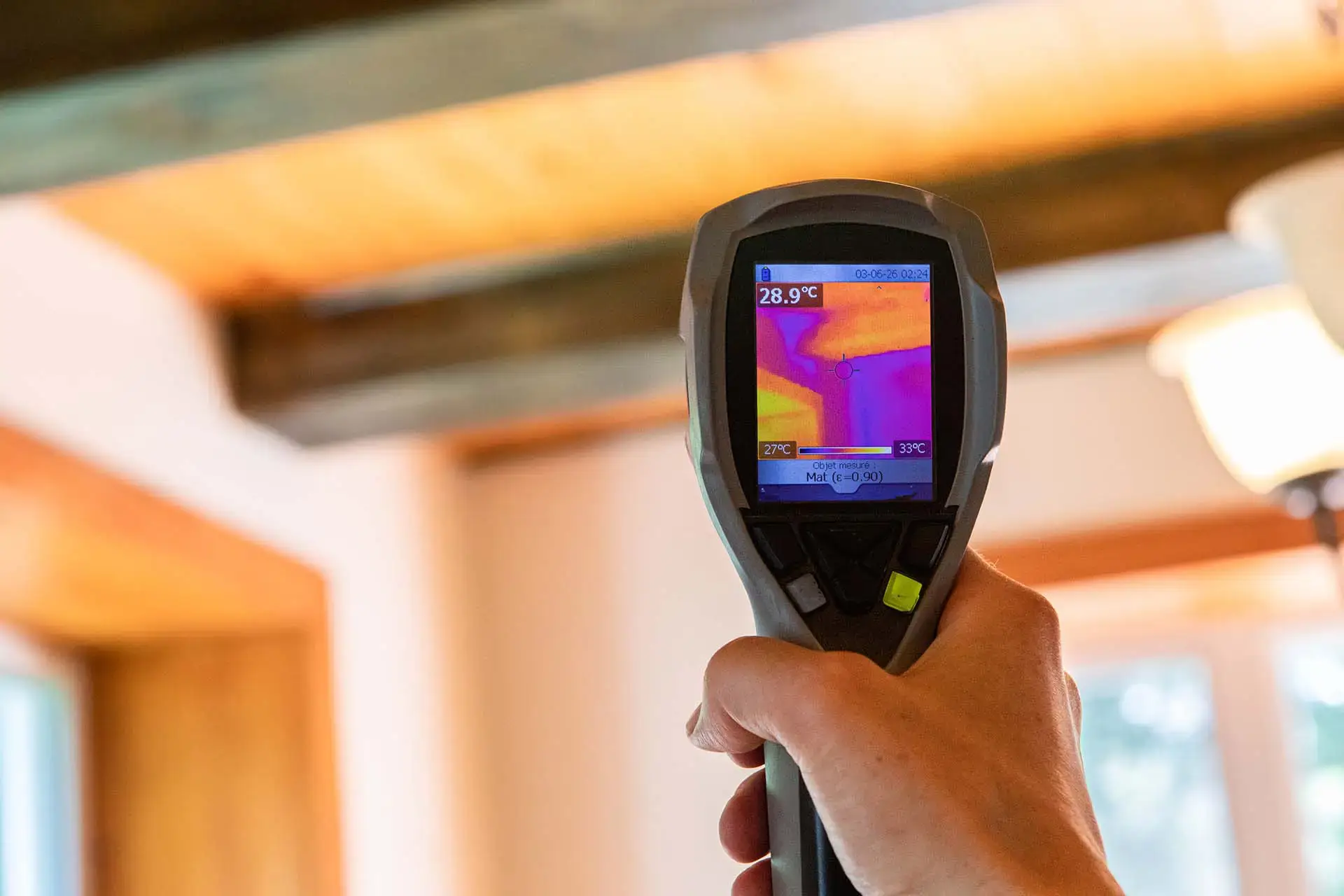
A thermal imaging survey uses advanced infrared technology to detect minute temperature differences on surfaces like walls, floors, and ceilings.
It is a common misconception that thermal cameras “see” water. Instead, they detect the evaporative cooling effect. Damp materials have a higher thermal mass and a different rate of evaporation than dry materials. This causes damp patches to appear as distinct “cold spots” on a thermal scan, even when the wall looks bone-dry to the human eye.
This level of detail is a core component of a comprehensive damp survey, providing a non-invasive way to “strip back” the walls without picking up a hammer.
Uncovering the root cause: Thermal bridging & condensation
One of the most complex forms of moisture ingress is condensation. However, “lifestyle factors” like drying clothes indoors are rarely the sole culprit. Often, the root cause is a structural defect known as thermal bridging.
What is thermal bridging?
Thermal bridging (or a “cold bridge”) occurs when a highly conductive material such as a steel lintel, a concrete floor slab, or a gap in cavity wall insulation creates a direct path for heat to escape the building. This results in a specific area of the internal wall being significantly colder than the rest of the surface. Which can often be the cause for damp spots and unexplained mould growth. A thermal imaging survey can provide visual evidence of these cold spots and provide you with the evidence you need.
Identifying the source with thermal surveys
When warm, moisture-heavy air inside a room hits these cold bridges, it reaches its “dew point” almost instantly, turning into liquid water. This is why mould often clusters in “sharp” geometric patterns in room corners or along window heads.
By using thermal imaging, we can:
-
Differentiate the cause: Thermal bridging has a distinct, sharp thermal signature. In contrast, penetrating damp or rising damp typically appears as “blossoming” or “creeping” patterns.
-
Provide definitive proof: A professional damp report backed by thermal data proves whether the issue is a structural failure or a ventilation problem, which is vital for landlord-tenant disputes or insurance claims.
What is moisture mapping?
While thermal imaging provides the visual evidence, it is only one half of the diagnostic equation. The actual verification process is known as moisture mapping.
Defining the process
Moisture mapping is the systematic process of using thermal imaging alongside electronic moisture meters (protimeters) and hygrometers to plot the exact spread of moisture. By recording these data points across a property, we create a digital map that reveals the intensity of the damp and its point of origin.
Why moisture mapping is essential:
Tracking hidden spread: Moisture often travels far from the initial leak. A moisture map shows the full “wet footprint,” ensuring that remediation covers the entire affected area, not just the visible stain.
Non-invasive verification: It provides a scientific baseline. Instead of guessing if a wall is dry, we provide hard data to monitor the drying process.
Is a professional survey worth the investment?
Many property owners hesitate due to the initial cost of a damp survey. However, the cost of a survey is a fraction of the price of an incorrect “cure.” Thousands of pounds are wasted every year on unnecessary damp-proof courses for issues that were actually caused by simple thermal bridging or a minor gutter leak.
The benefits of our data-driven approach:
-
Non-destructive: No need to damage décor to find the source.
-
Insurance ready: Our reports provide the “proof of damp” required by insurers.
-
Accurate remediation: We don’t just tell you the wall is wet; we tell you why it is wet and how to fix it permanently.
A success story
The damp survey is a vital first step in wider damp and moisture remediation. The damp survey is the platform that enables for accurate diagnosis and recommendations which allow professionals like Ideal Response to fully treat the issue. For commercial property owners and facilities managers, visit our Building Drying for Watford Colosseum case study to see the full remediation process from survey to drying. For homeowners, tenants and landlords, check out our Domestic Flooded Basement Cleanup to see how used thermal imaging to accurately treat the water ingress and restore the basement.
Summary
Damp is a structural challenge that requires a scientific solution. By utilising thermal imaging to identify thermal bridging and moisture mapping to track water spread, you stop the cycle of temporary fixes and address the root cause once and for all. Contact Ideal Response today and find out more about our thermal imaging and damp survey.
Call our emergency response team 0800 088 4170
Thermal imaging survey FAQs
What is a thermal imaging survey?
A thermal imaging survey uses advanced infrared technology to detect temperature variations on surfaces that are invisible to the naked eye. In the context of property maintenance, it identifies “cold spots” where insulation is missing or “damp spots” where moisture is causing evaporative cooling. This allows our technicians to see exactly what is happening behind your walls without having to tear them down.
Can thermal imaging actually find damp?
Yes, but with a scientific caveat. Thermal cameras do not “see” water; they see heat. Because damp materials hold thermal energy differently than dry materials—and often appear colder due to the evaporative cooling effect—the camera highlights these anomalies. We then use a physical moisture meter (protimeter) to confirm the presence of damp in the exact locations highlighted by the camera.
Does a thermal imaging survey require any structural damage?
Not at all. One of the primary benefits of a thermal imaging survey is that it is entirely non-destructive. We can scan entire rooms, ceilings, and floors without removing wallpaper, lifting floorboards, or drilling holes. It is the most non-invasive diagnostic tool available for modern property restoration.
How long does the survey take?
For a standard residential property, a comprehensive thermal imaging survey usually takes between 1 and 2 hours. This ensures we have enough time to calibrate the equipment to the internal environment and conduct a thorough walkthrough of all affected areas.
Do I need to do anything to prepare my property?
To get the most accurate results, we recommend keeping your heating on for a few hours prior to our arrival. A temperature difference (thermal gradient) between the inside and outside of the property makes it much easier for the camera to identify thermal bridging and insulation gaps.
What do I receive after the survey?
You will receive a detailed diagnostic report. This includes the high-resolution infrared “thermograms” alongside standard digital photos of the same areas for comparison. The report will explain the findings, identify the root cause of the damp or heat loss, and provide a clear roadmap for the necessary repairs or restoration.

Tahlia Ibrahim - Delivery Manager
Tahlia has over four and a half years of in-depth experience across various facets of the disaster recovery industry. Having progressed through roles in marketing and sales to her current position, Tahlia possesses a comprehensive understanding of the entire business operation, from initial client contact to meticulous service delivery. A certified BioSweep Specialist, she excels in advanced odour elimination techniques, ensuring thorough restoration.