Specialist Brick & Stone Cleaning Services | Ideal Response

Available 24/7 | 0800 088 4170

Brick and stone cleaning for heritage and period buildings

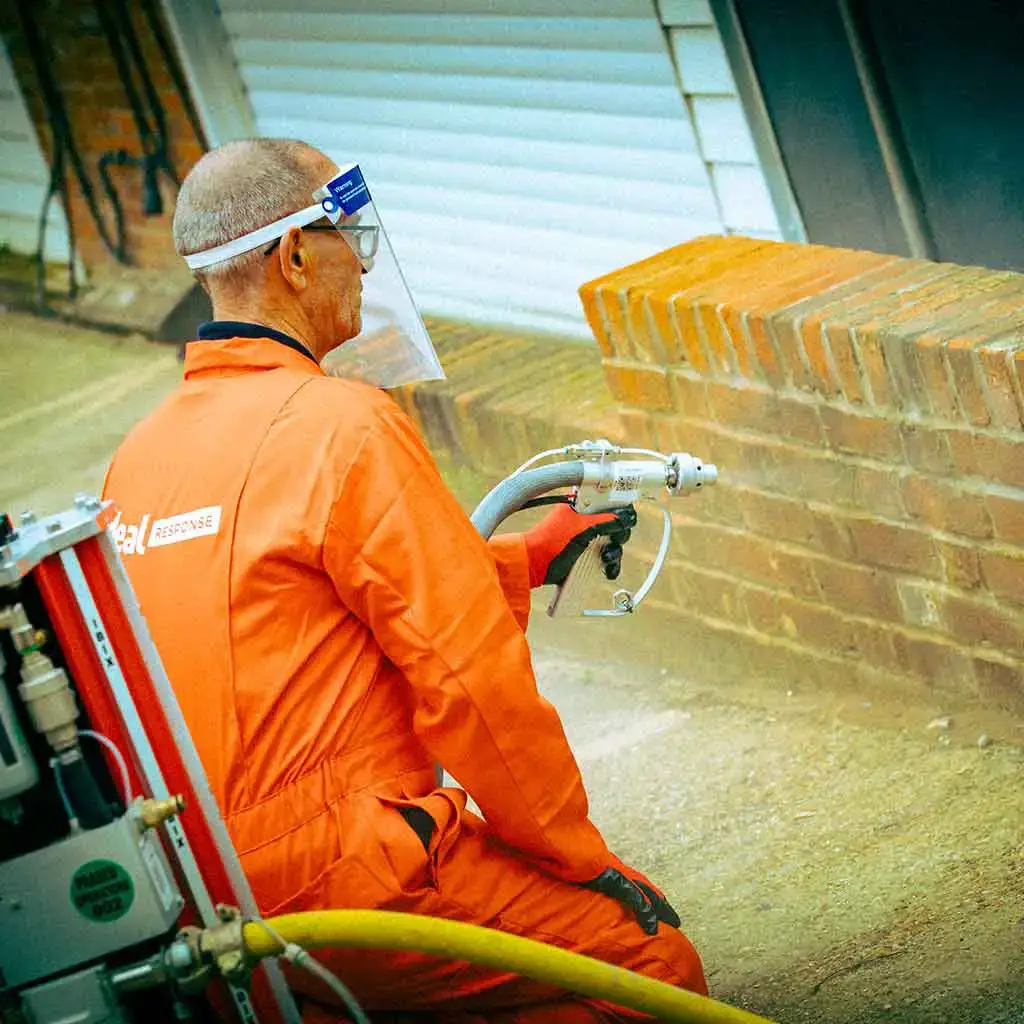
Old brick and natural stone are easily damaged by the wrong cleaning method. Ideal Response cleans masonry on listed, heritage and period buildings across London, Kent and the South East, using gentle systems such as DOFF steam and TORC, and always testing on a small area first.
Ideal Response commercial fire damage restoration project

Coverage: London, Kent and the South East

Brick and stone cleaning at a glance

The media is matched to the material, from soft walnut shell to fine glass bead, so it removes the contamination without damaging what is underneath. We used this on the Bromley car park project.

Listed and heritage buildings

Equipment we use

Recent brick and stone cleaning projects

Ideal Response technician in full PPE sand blasting
Completed section of the car park after a soot clean.

Ideal Response technicians using sand blasting to remove soot damage and how it looked finished.

How we carry out brick and stone cleaning

Cost factorWhy it matters
AreaSquare metres to clean
Material and conditionSoft or fragile masonry takes longer
ContaminationPaint, soot or carbon crusts need stronger methods
AccessScaffold, MEWP or rope access

Why choose Ideal Response for brick and stone cleaning

Accredited specialists
NACSC accredited specialist cleaners, CHAS Elite and SafeContractor approved
Proven results
Soot removal by precision sandblasting in a Bromley car park
Paperwork that stands up
Discreet, respectful teams, with waste transfer notes and certificates where you need them
Local teams across London, Kent and the South-East
From our head office in Maidstone and our London office, with ISO 9001, 14001 and 45001 certified systems
Independently reviewed
Read what customers say on Trustpilot, where we invite every customer to leave a review. Live rating shown by the Trustpilot widget.
Typical timescales
SituationTypical time on site
Small wall or chimney1 day
House front1–3 days
Larger or heritage buildingPlanned after test patches

Standards we work to: Historic England guidance on cleaning masonry

Heritage stone, brick and render are easily damaged by the wrong method. We use surface- specific, conservation-safe techniques and always test first.

01
DOFF superheated steam
Removes growth, paint and soiling without abrasion
02
TORC vortex system
Lifts carbon crusts from stone
03
Fine media (walnut shell, glass bead)
Controlled abrasion for stubborn deposits
04
Poultices
Draw out stains and salts
05
Moisture meters
Check masonry is not over-wetted

DOFF steam cleaning

High temperature, low pressure; lifts dirt without abrasion.

Micro-abrasion

A controlled, non-invasive way to remove surface soiling.

Conservation-safe graffiti removal

Removes paint while keeping detail intact.

Types of contamination on brick and stone

Appearance and value

Clean masonry lifts a home's kerb appeal and shows a commercial building is well looked after.

Protecting the building

Moss, algae and lichen hold moisture against the masonry. In freeze-thaw cycles that causes spalling and costly repairs, so removing growth protects the brick and stone as well as improving how it looks.

Step 1Identify the materialBrick, limestone, sandstone and granite each tolerate different methods.
Step 2Test patchTrial on a discreet area to confirm the method.
Step 3Clean gently firstDOFF steam for most soiling, growth and paint.
Step 4Escalate only if neededFine media blasting for baked-on soot or heavy staining.
Step 5ProtectOptional anti-graffiti or protective coatings where suitable.
Step 1Tell us about the buildingSend photos, the surface type and access details.
Step 2Survey and test patchWe assess the substrate and, where needed, trial the method on a small area first.
Step 3Quote, RAMS and bookingA fixed quote with risk assessments and method statements. Work is scheduled once payment is arranged.
Step 4CleaningThe agreed method, from DOFF steam to TORC or specialist gels, with access by MEWP, rope or scaffold.
Step 5HandoverBefore-and-after photos and a final inspection with you.

What brick and stone cleaning is

When sandblasting is the right choice

How much does brick and stone cleaning cost?

Brick and stone cleaning is priced after a survey and test patch.

What happens when you contact us

Need help now?

Call the team any time.

0800 088 4170
Available 24/7
CALL FOR IMMEDIATE HELPREQUEST A FREE QUOTE
What it is
Cleaning of brickwork, stone and masonry to remove dirt, carbon, paint, algae and staining
Methods
DOFF steam, TORC, fine media (walnut shell, glass bead) and, where suitable, sandblasting
Heritage
Gentle methods for listed and historic buildings
Cost
Quoted after survey and test patch
Not included
Repointing and stone repair

Soot removal by precision sandblasting in a Bromley car park

Types of contaminationSourceTypical treatment
Biological growthMoss, algae, lichenDOFF steam
Carbon crustsPollution on stoneTORC
Paint and graffitiVandalism or old coatingsDOFF or gels
SootFire or chimneysMedia blasting or specialist cleaning
Salts and stainingMoisture, iron, mortar runoffPoultices

Related services and guides

Some methods on listed buildings need consent. We provide risk assessments and method statements to support it.

Brick and stone cleaning removes dirt, pollution, carbon, paint and biological growth from masonry. The skill is choosing a method that cleans without eroding the surface or the mortar.

For contamination steam cannot shift, such as soot baked on after a fire, controlled media blasting provides the extra force.

  • Removes carbon and charred residue that steam struggles with
  • Restores the natural colour of brick or stone after ash fallout
  • Prepares the surface for protective coatings or paint
Location
Bromley, London
Duration
10+ working days
Service
Masonry Cleaning
Sector
Car park
A fire left concrete and masonry in a car park heavily coated in soot that earlier cleaning had not removed. Precision sandblasting and controlled decontamination removed the residue without damaging the surfaces, while the car park stayed in use.
Toufik Bouraine
Exterior Cleaning Specialist
“A fire can leave the same soot across several very different materials, but that does not mean they should all be cleaned in the same way. The concrete ceilings, soffits and pillars could take specialist sand blasting, while the walls, M&E and office finishes needed different levels of control. Test cleaning first gives you the evidence to choose a method that is strong enough to work without being unnecessarily aggressive.”

Talk to the team

For an emergency, call us. Otherwise send a few details and photos, and the team will get back to you.

Available 24/7

We’ll use your details to respond to your enquiry. View our Privacy Policy

JPG, JPEG, PNG, WEBP, HEIC, MP4, MOV, PDF — up to 5 files

Brick and stone cleaning: Frequently asked questions

Will cleaning damage the surface of my brick or stonework?
No. We specialise in non-abrasive restoration using the DOFF steam cleaning system. This method uses high-temperature steam at low pressure, effectively removing grime and biological growth without saturating the masonry or damaging the delicate “face” of the brick or stone.
What is DOFF cleaning, and how is it different?
DOFF cleaning is a high temperature – low pressure system for removing dirt and grime. It’s gentle on delicate surfaces and perfect for heritage buildings or areas where traditional methods might be too harsh.
What is the difference between DOFF and pressure washing?
Pressure washing relies on high-impact force which can erode mortar and drive moisture deep into the substrate. DOFF cleaning uses super-heated steam (up to 150°C) at very low pressure. It is far gentler and more effective at killing organic spores, ensuring a longer-lasting clean.
Can you remove paint from old masonry?
Yes. For paint removal, we often utilise the TORC system (an evolution of the JOS system). It uses a gentle swirling vortex of low-pressure air, water, and a fine granulate to safely lift paint, carbon crusting, and lime scale without harming the underlying material.
How long does the cleaning process take?
The duration depends on the size of the property and the level of staining. A standard residential terrace in London or Kent typically takes 1–3 days. We provide a detailed timeline following our initial site survey.
Does the process require chemicals?
In most cases, no. Our steam-based systems are environmentally friendly and achieve superior results using only water. If a chemical agent is required for specific heavy staining (such as metallic oxidisation), we use biodegradable, masonry-safe solutions.
Will cleaning help with damp issues?
Yes. Removing layers of non-breathable dirt, moss, and old paint allows the masonry to “breathe” naturally. This facilitates the evaporation of trapped moisture, which is a key factor in resolving many types of penetrating damp.
Can you clean heritage or listed buildings?
Absolutely. Our methods are approved by heritage professionals for use on Grade I and Grade II listed structures. We focus on preservation, ensuring the historical integrity of the building is maintained throughout the restoration.
Do you provide services across London and Kent?
Yes. We operate fully equipped restoration teams out of our London and Kent hubs, covering everything from central London boroughs to Maidstone, Canterbury, and the surrounding areas.