When people think about fire risk in the home, they tend to picture something sudden. It could be a spark, a fault.
or an immediate emergency.
But in reality, many fires, particularly in kitchens, develop gradually.
According to data published by the UK Fire and Rescue Service, cooking appliances are consistently the leading cause of accidental house fires in the UK, accounting for tens of thousands of incidents every year. A significant proportion of these are linked to fat and grease ignition.
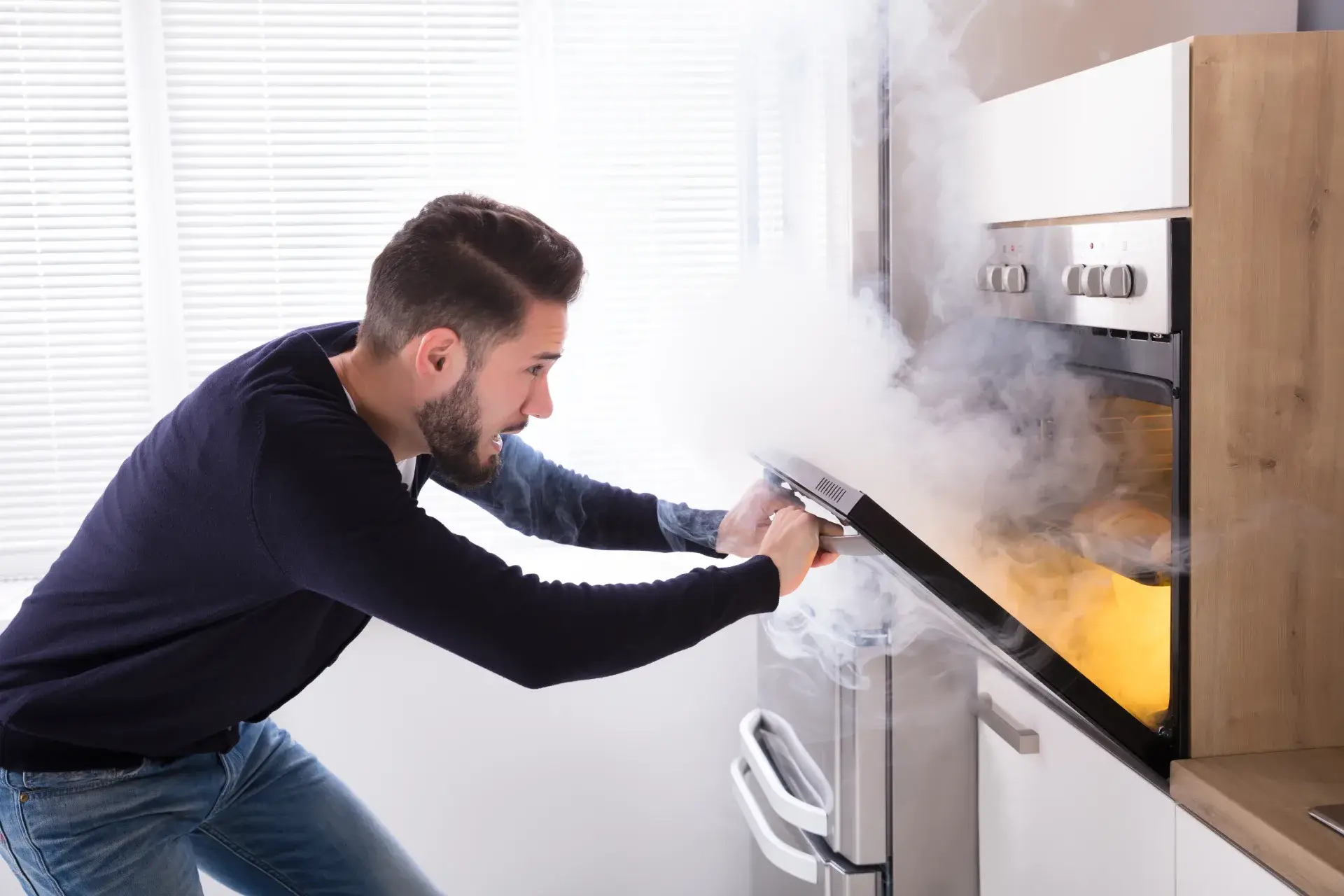
That matters, because a smoking oven is often part of that same process. Not the end result, the stage before it.
Skip to:
What oven smoke actually is (and why it shouldn’t be ignored)
The critical link between smoke and fire
Why grease is the real risk factor
The health impact: More than just an unpleasant smell
Why smoke rarely stays contained to the oven
When a smoking oven becomes a genuine fire risk
What to do and what not to ignore
Prevention is simple but often overlooked
When it stops being an oven issue and becomes a property contamination problem
What oven smoke actually is (and why it shouldn’t be ignored)
Smoke from an oven isn’t just ‘burning food’. It’s the visible result of thermal decomposition, where substances break down under heat before they fully ignite.
In a typical domestic oven, this usually involves:
- Accumulated cooking fats and oils
- Carbonised food residue
- Cleaning agents that haven’t been fully removed
As temperatures rise, these materials begin to degrade and release:
- Volatile organic compounds (VOCs)
- Fine particulate matter (PM2.5 and smaller)
- Partially combusted carbon particles
This is why oven smoke often appears dark, smells strong, and lingers.
The critical link between smoke and fire
One of the biggest misconceptions is treating smoke and fire as separate problems. They aren’t. Smoke is produced as materials approach ignition conditions.
In the case of ovens:
- Grease vapours become increasingly volatile at high temperatures
- Oxygen is present in the cooking environment
- Heat is sustained and often enclosed
This creates the exact conditions needed for ignition. Basically, a smoking oven is often a system already moving towards fire, not away from it.
Why grease is the real risk factor
Grease behaves very differently to other types of residue. When heated repeatedly, it:
- Breaks down into more flammable compounds
- Spreads across oven surfaces, increasing exposure
- Ignites at relatively predictable temperature ranges
This is why grease-related incidents are a leading factor in kitchen fires.
The London Fire Brigade has repeatedly highlighted cooking with fats and oils, particularly when build-up is present, as one of the most common causes of domestic fires.
A smoking oven containing grease deposits is not a minor issue, it’s a known fire risk.
The health impact: More than just an unpleasant smell
Even where fire doesn’t occur, oven smoke affects indoor air quality.
The particles released during heating are small enough to be inhaled deeply into the lungs, particularly in enclosed kitchens with limited ventilation.
Guidance from the UK Health Security Agency confirms that exposure to indoor air pollutants, including fine particulates and VOCs, can contribute to:
- Irritation of the respiratory system
- Exacerbation of asthma and existing lung conditions
- Short-term symptoms such as coughing or eye irritation
While occasional exposure may be limited, repeated exposure in domestic environments is not risk-free.
Why smoke rarely stays contained to the oven
Once released, smoke behaves as a contaminant. It doesn’t stay localised.
- Smoke travels with air movement throughout the kitchen
- It settles onto surfaces and soft furnishings
- Bonds with materials such as wood, paint and fabrics
This is why even a relatively minor smoking incident can leave behind:
- Persistent odours
- Greasy surface films
- Gradual discolouration
Over time, this can develop into a broader indoor contamination issue, not just an appliance problem.
When a smoking oven becomes a genuine fire risk
There’s a clear threshold where a smoking oven shifts from inconvenience to hazard.
This typically includes situations where:
- Smoke is frequent or increasing
- The source of the smoke is unclear
- Grease build-up is visible long-standing
- The oven is left unattended while in use
At this point, the conditions required for ignition are already present and importantly, many kitchen fires occur during routine use, not extreme scenarios.
What to do and what not to ignore
If your oven starts smoking, the response should be immediate but controlled. Turn the appliance off and allow it to cool before inspecting it. In many cases, the issue will be identifiable:
- Burnt residue
- Grease accumulation
- Debris on trays or the oven base
A thorough clean will often resolve the issue, but only if the source is fully removed.
Where the cause is not obvious, or the issue persists after cleaning, it may indicate:
- Residue in inaccessible areas
- A mechanical or electrical fault
- Deeper contamination within the appliance
Continuing to use the oven in this state increases the risk rather than resolving it.
Prevention is simple but often overlooked
Most smoking ovens are not the result of a single event. They develop gradually. Small amounts of residue build up over time, eventually reaching a point where they begin to smoke under normal operating temperatures. Reducing the risk comes down to consistency:
- Regular cleaning before build-up becomes visible
- Using trays or liners to contain spills
- Avoiding excessive use of cleaning products that leave residues
- Maintaining ventilation during use
None of these are complex, but they are often neglected until a problem appears.
When it stops being an oven issue and becomes a property contamination problem
When an oven produces heavy smoke, or ignites, the impact doesn’t stay contained within the appliance.
What you’re dealing with at that point isn’t just heat or visible smoke. It’s a mixture of airborne contaminants made up of partially combusted materials, grease particles and gases released during high-temperature breakdown. Once those particles are released, they don’t behave in a controlled way.
They move rapidly through the property, carried by natural air currents and pressure differences, often reaching areas well beyond the kitchen itself.
How smoke spreads further than most people expect
In an enclosed environment, smoke will:
- Rise quickly and spread across ceilings
- Move through doorways, hallways and ventilation paths
- Settle into cooler areas of the property as it disperses
This means that even a relatively short-lived incident can affect:
- Adjacent rooms
- Upper floors
- Soft furnishings and stored items
In many cases, the visible damage is only a fraction of the actual spread.
What happens when smoke particles settle
As smoke cools, the particles it carries begin to deposit onto surfaces. These deposits are often:
- Microscopic and not immediately visible
- Greasy or carbon-based in composition
- Capable of bonding to porous materials
This is where the longer-term issues begin. Materials such as paint, timber, fabrics and painted surfaces can all absorb or retain these residues to some degree. Once that happens, the problem is no longer surface-level.
Why standard cleaning doesn’t solve the problem
Conventional cleaning methods are designed to remove visible dirt, not bonded contaminants.
Wiping surfaces or using household cleaning products may:
- Improve appearance temporarily
- Reduce surface residue
- Mask odours for a short period
But they rarely:
- Remove contaminants from within materials
- Break down the compounds causing odours
- Prevent the issue from returning over time
This is why smoke smells often come back, sometimes days or weeks later.
The shift from cleaning to decontamination
At this stage, the focus changes completely. It’s no longer about making the space look clean. It’s about removing contamination at a level that can’t be seen.
That involves:
- Addressing both surface and absorbed residues
- Treating odours at their source, not masking them
- Ensuring the environment is returned to a stable, safe condition
Because without that, the effects of the incident don’t fully go away, they just become less obvious for a period of time.
This is the point where a smoking oven stops being a maintenance issue and becomes a restoration problem.
A smoking oven is a known fire risk and not a minor issue
A smoking oven is not just an inconvenience.
In most cases, it is the result of heat acting on grease, food residue or other materials inside the appliance, the same conditions that lead to ignition if left unchecked.
Across the UK, cooking appliances remain the leading cause of accidental house fires, with grease and fat playing a significant role in many of those incidents. Smoke is often present before those fires develop.
Once smoke is being produced regularly, the issue has already progressed beyond normal use.
At that point:
- Residues are breaking down under heat
- Flammable vapours may be present
- Contamination is no longer contained to the appliance itself
This is not a situation that resolves on its own. If ignition occurs, or heavy smoke is produced, the impact extends into the property.
Smoke contamination can:
- Spread beyond the kitchen
- Settle into materials and surfaces
- Leave residues and odours that standard cleaning does not remove
A smoking oven is an early-stage warning of a process that can lead to fire and wider damage.
Ideal Response supports properties across the UK where fire or smoke damage has occurred, providing specialist cleaning and decontamination to return environments to a safe, usable condition.
If your property has been affected, contact our expert team to see how we can help.
Frequently asked questions about smoking ovens and fire risk
How common are kitchen fires caused by ovens in the UK?
Cooking appliances are the leading cause of accidental house fires in the UK. Data from the UK Fire and Rescue Service shows that tens of thousands of incidents each year are linked to cooking, with grease and fat being a major contributing factor.
Ovens are part of that category, particularly where build-up has been allowed to develop over time. While not every smoking oven leads to a fire, many fires follow the same pattern of heat, residue and eventual ignition.
Is a smoking oven always dangerous, or can it be harmless?
Not every instance of smoke is immediately dangerous, but it should never be ignored.
A one-off issue, such as a small spill burning off, may resolve once cleaned. However, repeated or persistent smoke usually indicates a build-up of grease or residue that is being heated to the point of decomposition.
That is the same process that can lead to ignition if conditions continue.
What temperature does grease ignite at inside an oven?
Most cooking oils and fats have a flash point typically between 160°C and 300°C, depending on the type.
Domestic ovens can easily operate within or above this range, particularly during grilling or high-temperature cooking.
If grease is present and repeatedly heated, it can reach a point where vapours ignite, which is how many oven-related fires begin.
Why does my oven keep smoking even after I’ve cleaned it?
If smoke continues after cleaning, it usually means one of three things:
- Residue remains in areas that are difficult to access
- Grease has built up over time and hasn’t been fully removed
- Cleaning products have left a film that is reacting to heat
In some cases, it may also indicate a fault within the appliance. If the cause isn’t clear, continued use increases risk rather than resolving the issue.
Is breathing in oven smoke harmful?
Oven smoke contains fine particles and gases released during the breakdown of food and grease.
Guidance from the UK Health Security Agency highlights that indoor air pollutants like these can irritate the lungs and airways, particularly in enclosed or poorly ventilated environments.
People with asthma or other respiratory conditions are more likely to be affected.
Can a smoking oven cause damage to my kitchen even without a fire?
Yes. Even without ignition, smoke can spread and settle onto surfaces throughout the kitchen.
Over time, this can lead to:
- Greasy residues on cabinets and walls
- Persistent odours
- Gradual staining or discolouration
Repeated exposure makes these effects more difficult to remove using standard cleaning.
When should I stop using my oven due to smoke?
You should stop using your oven if:
- Smoke is persistent or getting worse
- The source isn’t clearly identifiable
- The issue continues after cleaning
- There is a strong or unusual smell
At that point, the appliance is no longer operating normally and should be investigated before further
What’s the difference between normal cooking smoke and a warning sign?
Normal cooking may produce small amounts of steam or light smoke during high-heat cooking. A warning sign is when:
- Smoke appears at lower temperatures
- It occurs every time the oven is used
- The smell is strong, burnt or chemical
- Residue is visible inside the oven
Consistency is the key difference, recurring smoke indicates an underlying issue.
If my oven catches fire, will the damage be limited to the appliance?
In most cases, no. Once a fire or heavy smoke event occurs, the impact can extend beyond the oven itself. Smoke and heat can affect surrounding surfaces, and contamination can spread through the property.
Even small fires can result in wider smoke damage that requires more than basic cleaning.
When is professional smoke damage cleaning needed?
Professional cleaning is typically required when:
- Smoke has spread beyond the oven or immediate area
- Odours persist despite cleaning
- Residues have settled into surfaces or materials
- There has been any form of ignition or fire
At this stage, the issue becomes one of decontamination rather than cleaning, as the aim is to remove embedded residues and restore the environment properly.