Available 24/7 | 0800 088 4170

Available 24/7 | 0800 088 4170
When a fire happens in a property, the focus is almost always on the flames. But speak to anyone who deals with fire-damaged buildings regularly, and a different picture emerges. The fire is often only the starting point.
In the UK, fire and rescue services attend hundreds of thousands of incidents every year, and even relatively small fires can require significant volumes of water to bring under control. That water doesn’t just extinguish the flames it soaks into the building itself and once it’s there, it doesn’t simply dry out on its own.
What makes this more problematic is that the damage isn’t immediately obvious. A property can look stable within days:
But inside the structure, the conditions are very different.
According to guidance from the Health and Safety Executive, damp environments can quickly lead to deterioration of materials and increased risk of mould growth, particularly in enclosed or poorly ventilated spaces. This is where many fire recovery projects go wrong because the visible damage is addressed but the hidden moisture isn’t.
This is exactly why structural drying isn’t an optional extra, it’s a critical stage in returning a property to a safe, stable condition.
If you’re dealing with fire damage, or responsible for managing the recovery, this guide will explain:
Because without addressing what’s happening beneath the surface, the recovery process is only ever partial.
Skip to:
How water from firefighting moves through a building
Why buildings don’t simply ‘dry out’ on their own
What’s happening inside the materials (and why it matters)
The overlooked link between fire damage and secondary damage
What happens if structural drying is skipped
What structural drying actually involves (in practice not just in theory)
Why structural drying sits between damage and rebuild and can’t be skipped
Water introduced during a fire doesn’t behave like a slow leak.
It is applied rapidly, often under pressure, and across multiple areas at once. As a result, it travels further and penetrates deeper than most people expect.
It can move into:
Even when the surface appears dry, these areas can retain moisture for extended periods. This is what makes fire-related water damage particularly difficult to assess without proper inspection.
There’s a common assumption that once the immediate aftermath is dealt with, a property will dry naturally over time. In reality, several factors prevent that from happening effectively. Building materials are designed to be durable, not to release moisture quickly. Plasterboard, timber and insulation can all retain water internally, long after the surface has dried.
At the same time, the areas where moisture accumulates, such as voids and cavities, have very limited airflow.
This creates a situation where:
So while the property may look ready for the next stage, it often isn’t.
When materials absorb water, their internal structure changes:
At the same time, elevated moisture levels create the conditions for biological activity. Microorganisms begin to develop, particularly in materials that contain organic content. As they grow, they can produce gases that contribute to odours and reduced air quality.
This is not immediate, but it is predictable and once it starts, it becomes more difficult to reverse.
One of the most important, and most overlooked, aspects of fire recovery is that it is rarely just about fire. It’s a combined event. Heat, smoke and water all interact with the building at the same time. For example:
This combination increases the risk of longer-term damage if not addressed properly.
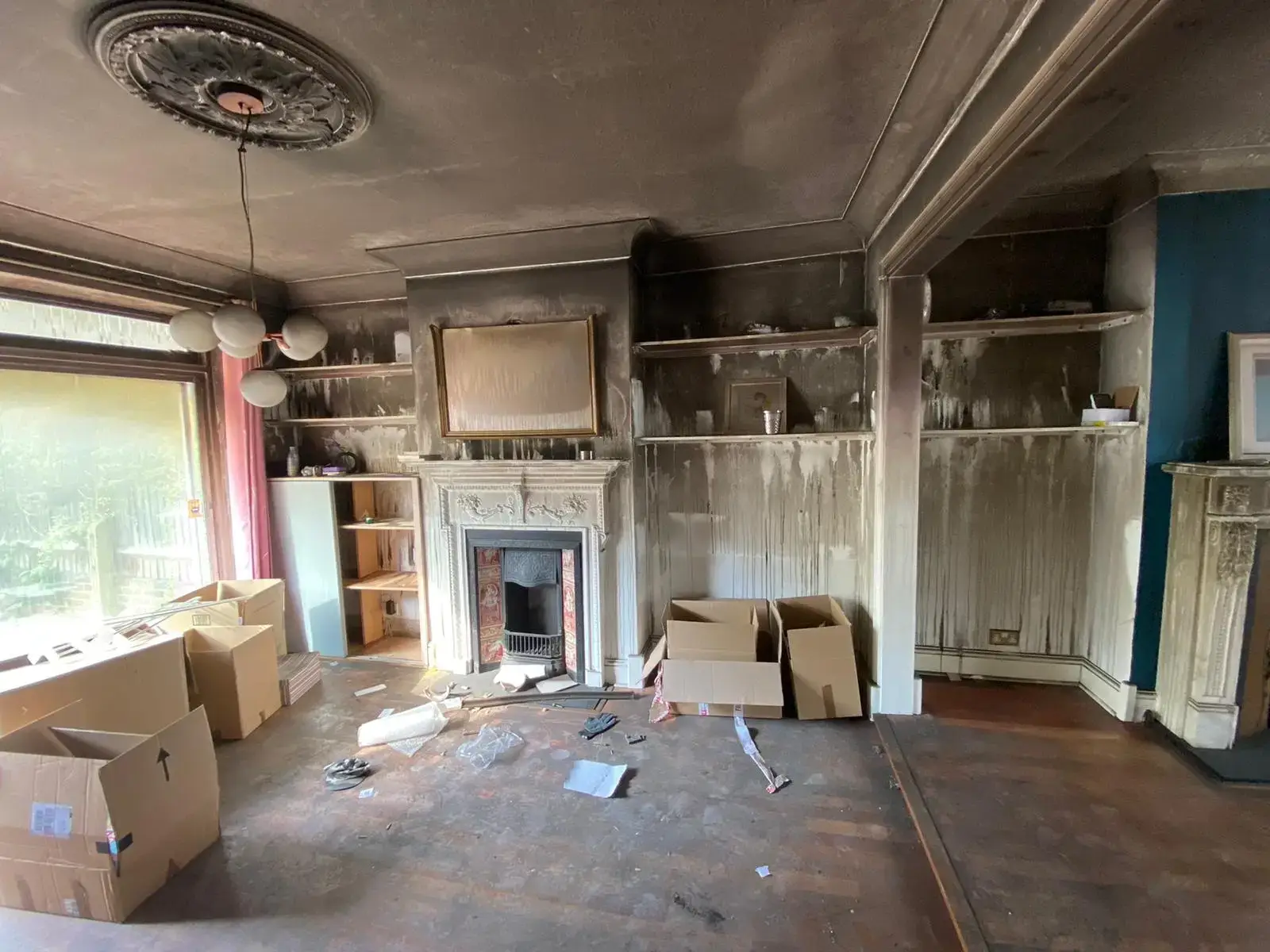
In situations where structural drying is not carried out, the consequences tend to appear gradually rather than immediately. Over time, this can lead to:
From a practical perspective, this often results in delays to reinstatement and additional costs later in the process. In many cases, addressing these issues retrospectively is more disruptive than resolving them at the outset.
Structural drying is often misunderstood as simply ‘drying a building out’.
In reality, it’s a measured, controlled process that focuses on removing moisture from within materials, not just from the air or visible surfaces.
After a fire, water doesn’t sit neatly where it lands. It migrates. Driven by gravity, heat and material density, moisture moves laterally and vertically through a structure. That means the visible wet areas are rarely the full picture and in many cases, not even the most affected areas.
The first step is understanding that movement.
Before any drying begins, the structure needs to be assessed properly. This involves using specialist moisture detection equipment to build a moisture map of the property – identifying:
This stage is critical because drying without accurate mapping often leads to missed areas, which later become the source of further problems.
Once the extent of moisture is understood, the environment within the property is deliberately controlled.
This isn’t just about placing equipment, it’s about creating the right conditions for moisture to leave materials. That typically involves:
The goal is to create a moisture gradient, where water naturally moves out of materials and into the air, where it can then be removed.
Different materials behave differently when wet.
Because of this, drying isn’t uniform, it has to be managed based on the material. In some cases, this may involve:
This is the stage where superficial drying often fails, because the moisture you can’t see is the hardest to remove.
One of the defining differences between proper structural drying and basic drying is verification. Moisture levels are regularly measured throughout the process to track progress and ensure that materials are returning to acceptable levels. This prevents two common issues:
Drying isn’t complete when the property feels dry, it’s complete when it tests dry.
The end point of structural drying isn’t just dryness, it’s stability. That means:
Only at this point can the property move forward safely. Because until then, any further work is being carried out on an unstable foundation.
One of the most common misunderstandings in fire recovery is where structural drying fits into the process. It’s often seen as optional or something that can happen in parallel with repairs.
In reality, it sits at a critical transition point – between damage and reinstatement.
Reinstatement involves rebuilding, repairing and redecorating. But all of those activities assume one thing which is that the structure underneath is stable. If moisture is still present:
This is why starting reinstatement too early often leads to rework. Not immediately, but weeks or months later.
One of the most serious risks is sealing moisture inside the structure. For example:
This traps moisture where it can’t escape. Over time, that can lead to:
It might seem counterintuitive, but taking time to dry a structure properly often speeds up the overall recovery. That’s because it prevents:
In other words, skipping or rushing this stage doesn’t save time, it moves the problem further down the line.
By the time structural drying is complete, the property should be:
That’s the point where reinstatement can begin with confidence.
By the time a fire has been dealt with, most of the obvious damage has already been handled. What’s left is less visible and that’s exactly why it causes issues.
Water from firefighting doesn’t just sit on surfaces. It gets into the structure, and once it’s there, it changes how the building behaves. Materials hold onto it, release it slowly, and in some cases start to deteriorate because of it.
That doesn’t always show up straight away.
In fact, most of the problems linked to this only become clear later, when parts of the property don’t perform as expected, or when work that should have lasted starts to fail earlier than it should.
There’s a point in every fire recovery where the focus shifts. It moves from dealing with what’s happened… to making sure nothing else develops afterwards.
That’s where structural drying sits.
It’s not the most visible part of the process, and it’s not always the part people prioritise, but it’s the one that determines whether the property is actually ready to move forward.
If that step is done properly, everything that follows tends to go as it should.
If it isn’t, the same issues tend to come back, just in a different form, and usually at a worse time.
Ideal Response supports fire-damaged properties across the UK by carrying out structural drying to bring buildings back to a stable condition, ready for reinstatement to begin.
Contact the team for expert support .

Chris Hedges is Head of Marketing at Ideal Response and the author of every article published on this site. With over 25 years of senior marketing experience across property, legal, and professional services sectors, Chris brings a clear, evidence-led approach to writing about fire damage, flood restoration, and specialist property remediation. His philosophy is simple: cut through the noise, respect the reader's time, and give people the information they actually need.
Explore more articles about damage restoration, specialist cleaning and what we do



If you’re dealing with fire damage, flooding, or an environmental incident, our team is ready to respond. No matter if you have a question or have an emergency that you need help with, call:
If you’d prefer to drop us a message, use our main contact form and upload any pictures of the incident. Would you like us to call you? Fill out the short ‘Request a call back’ form.