For many property owners, a kitchen fire feels contained. The flames are put out quickly. Damage looks limited to a hob, an oven or a section of worktop. On the surface, it may even appear manageable. But then the problems start to show.
- A persistent smoke smell that won’t shift
- Greasy soot appearing on surfaces hours later
- Staining that comes back after cleaning
- Contamination spreading beyond the kitchen
According to the UK Home Office, cooking-related incidents account for around 50% of accidental fires in UK homes and many of these are relatively small in scale. Yet ‘small’ fires are often the ones that leave the most misunderstood damage behind.
Because what matters isn’t just the fire, it’s everything the fire leaves behind.
Skip to:
Why kitchen fires are so difficult to fully clean
What fire damage in a kitchen really looks like (beyond the obvious)
The three types of damage you’re actually dealing with
What most property owners miss after a kitchen fire, and why it becomes a bigger problem
A real-world kitchen fire scenario
When a kitchen fire becomes a restoration job and not a standard cleaning task
Conclusion: It’s not the fire, it’s what the fire leaves behind
Why kitchen fires are so difficult to fully clean
Kitchen fires behave differently to most other types of fire. They typically involve:
- Cooking oils and fats
- Food residues
- High heat in a confined area
This creates a very specific type of contamination – grease-based soot
Unlike dry soot from other fires, this type:
- Sticks aggressively to surfaces
- Smears when wiped
- Embeds into materials
- Bonds with existing kitchen grime
This is why standard cleaning often makes things worse rather than better. Visit our Fire Damage Cleaning & Decontamination case study to see what successful remediation looks like. You can also see how we helped a London resident recover from fire damage in Smoke & Soot Deposit Cleaning case study.
What fire damage in a kitchen really looks like (beyond the obvious)
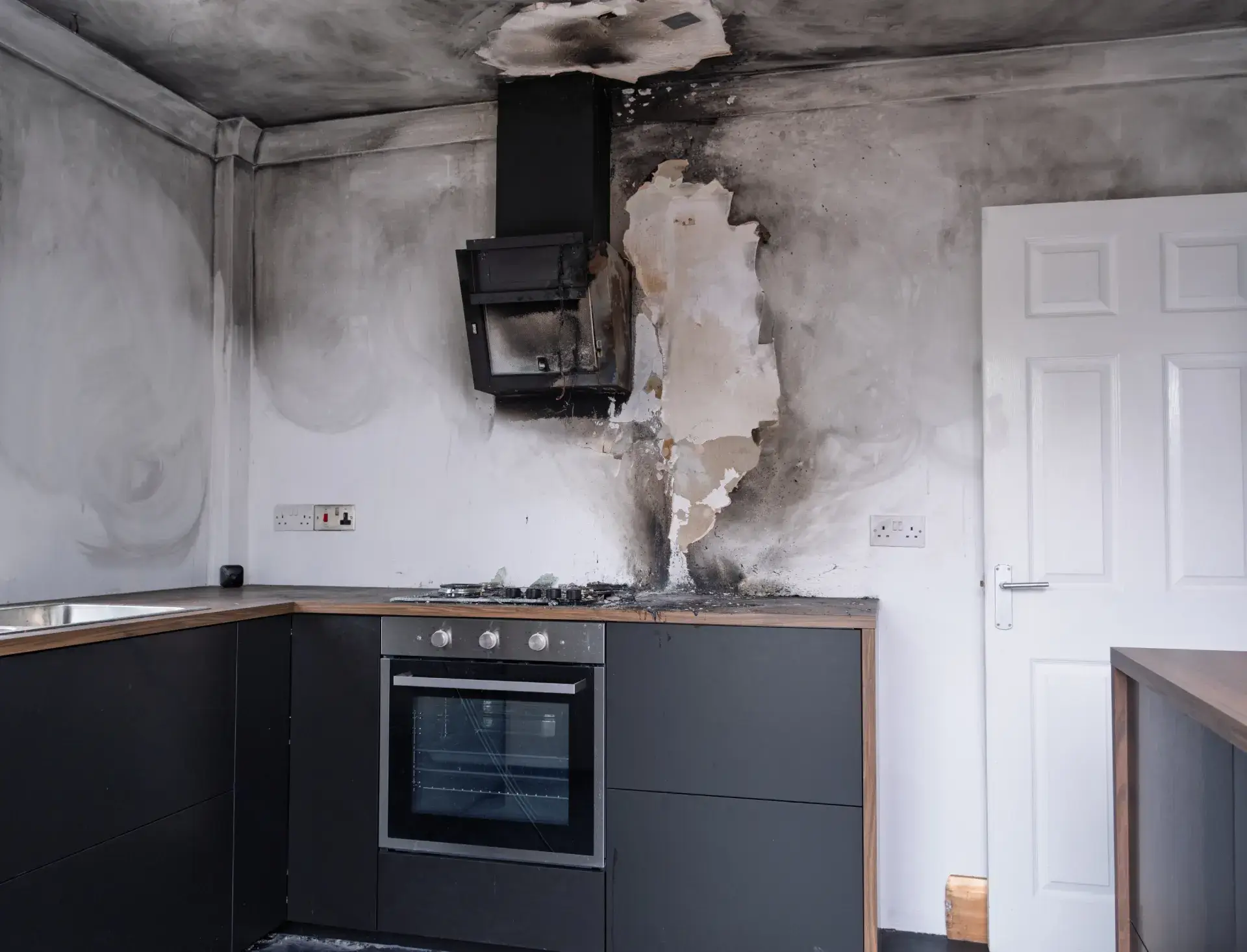
After a kitchen fire, visible damage is only part of the story. In real scenarios, we often see:
- Soot inside cupboards, even when doors were closed
- Contamination on the back of appliances
- Residue inside extractor fans and ducting
- Smoke deposits on ceilings well outside the kitchen
This happens because hot smoke rises rapidly and spreads before the fire is even extinguished.
The three types of damage you’re actually dealing with
Understanding this is key to why restoration is more involved than it seems.
1. Heat damage (what you can see)
This includes:
- Warped cabinet doors
- Blistered paint or finishes
- Damaged worktops
- Compromised appliances
This is usually the most obvious and often the least complex part.
2. Soot and residue (what spreads everywhere)
Soot from kitchen fires:
- Coats surfaces in a thin, greasy film
- Settles unevenly across rooms
- Bonds with moisture and existing dirt
Left untreated, it can cause long-term staining and material damage. This is why soot and ash cleaning is so important.
3. Smoke and odour (what lingers)
Smoke particles penetrate:
- Walls and ceilings
- Sealants and joints
- Soft furnishings in adjacent rooms
This is why the smell often remains long after visible cleaning. So, smoke odour removal is a vital part of the fire damage cleaning process.
What do most people miss after a kitchen fire?
This is where many kitchen fire incidents start to go wrong. After the initial clean-up, it’s common for property owners to think:
‘It looks clean now’ or ‘The worst is over.’
And in many cases, visually, that seems true. But kitchen fires are responsible for around half of all accidental dwelling fires in the UK, according to the UK Home Office and a large proportion of these are relatively small, contained incidents.
These are also the incidents most likely to be underestimated.
Within days of a ‘cleaned’ kitchen fire, problems often start to return:
- Staining reappears on walls and ceilings
- Smoke odours come back, sometimes stronger
- Surfaces feel greasy or tacky again
This happens because the source of contamination hasn’t been fully removed particularly grease-based soot and smoke particles embedded in materials.
The ongoing impact of incomplete fire damage restoration
When fire damage isn’t properly addressed, it doesn’t just linger, it escalates.
Common long-term issues include:
- Persistent smoke odours that won’t fully disappear
- Staining and discolouration returning over time
- Corrosion of metal surfaces and kitchen appliances
- Degradation of finishes and materials
For landlords, property managers and commercial spaces, the consequences can be more significant:
- Delays in re-letting or reopening
- Complaints from tenants or occupants
- Reputational impact
- Higher repair costs later
In many cases, what starts as a relatively contained incident becomes a more complex and costly restoration job simply because it wasn’t fully resolved the first time.
A real-world kitchen fire scenario
A typical callout might involve a small pan fire. The fire is extinguished quickly, with visible damage limited to:
- The hob area
- A section of worktop
- Nearby cupboards
However, within 24 hours:
- Soot has spread across all
- Kitchen surfaces
- Smoke odour has reached adjoining rooms
- Residue is found inside cupboards and on ceilings
What initially looked minor becomes a full-room decontamination job.
When a kitchen fire becomes a restoration job and not a standard cleaning task
There is a clear point where a kitchen fire moves beyond something that can be resolved with standard cleaning. In many cases, that point comes sooner than expected.
You should seriously consider professional restoration when:
- Soot is visible across multiple surfaces not just near the source
- Smoke odour remains after initial cleaning attempts
- Surfaces feel greasy or residue continues to reappear
- Contamination has spread beyond the kitchen into adjoining areas
- You are unsure how far smoke or soot has travelled
At this stage, the issue is no longer surface-level. It becomes a matter of removing embedded contamination, protecting materials and fully restoring the environment and not just improving how it looks.
Early intervention here is key. The longer soot and smoke residues remain in place, the more they bond with surfaces, making restoration more complex and more costly.
What professional kitchen fire restoration actually involves
Professional restoration is a structured process designed to deal with both visible damage and hidden contamination, something standard cleaning cannot achieve.
Detailed damage and contamination assessment
The first step is understanding the full extent of the damage. This goes beyond what can be seen, identifying:
- Hidden soot deposits
- Smoke spread into adjacent areas
- Contamination inside cupboards, voids and ventilation systems
This ensures nothing is missed before work begins.
Controlled soot and residue removal
Soot, especially grease-based soot from kitchen fires, must be removed carefully.
Incorrect cleaning can smear or spread contamination further. Specialist techniques are used to:
- Lift residues from surfaces
- Prevent cross-contamination
- Protect underlying materials
Deep cleaning of affected areas
All impacted surfaces are thoroughly cleaned, including areas often overlooked such as:
- Inside cupboards and drawers
- Behind and beneath appliances
- Ceiling spaces and high-level surfaces
This is where most DIY attempts fall short.
Odour neutralisation at source
Lingering smoke odour is not just in the air, it’s embedded within materials.
Professional treatment focuses on:
- Breaking down odour-causing particles
- Treating affected materials directly
- Ensuring smells do not return over time
Repair, finishing and restoration
Once contamination is removed, attention turns to restoring the kitchen itself. This may involve:
- Repairing or refinishing surfaces
- Addressing heat-damaged materials
- Returning the space to a safe, functional and presentable condition
Conclusion: It’s not the fire, it’s what the fire leaves behind
Kitchen fires are common across the UK, but the real challenge is not the fire itself. It’s the residue, smoke and contamination left behind. The key points are simple:
- Kitchen fires create complex, grease-based contamination
- Damage spreads further than it first appears
- Incomplete cleaning leads to recurring problems
The difference between a quick fix and a proper recovery is how thoroughly the damage is dealt with.
If your kitchen has been affected by fire or smoke, Ideal Response provides specialist fire damage restoration services across the UK, helping properties return to a safe, clean and fully usable condition.
Speak to the team today for expert advice and rapid response.
Call our emergency response team 0800 088 4170
Frequently asked questions about kitchen fire damage
Can a small kitchen fire really cause serious damage?
Yes and this is one of the most common misconceptions.
Even when flames are contained quickly, kitchen fires produce grease-based soot and dense smoke that can spread far beyond the immediate area. In many cases, the visible damage is minor, but contamination has already affected cupboards, ceilings and adjoining rooms.
Why does my kitchen still smell of smoke after cleaning?
Because the smell isn’t just in the air it’s embedded in materials.
Smoke particles penetrate surfaces such as paint, sealants, wood and even hidden areas like inside cupboards or extractor systems. Unless these particles are properly treated at source, the odour will continue to return.
Is kitchen fire soot different from other types of soot?
Yes and it’s significantly more difficult to deal with.
Kitchen fires typically produce grease-based soot, which is sticky, smears easily and bonds to surfaces. Standard cleaning methods often spread it further rather than removing it completely.
How far can smoke and soot travel from a kitchen fire?
Further than most people expect. Even a small fire can allow smoke to travel through:
- Open doorways
- Ventilation systems
- Natural air movement within the property
This means contamination is often found in rooms that were not directly affected by the fire.
Will repainting or redecorating fix fire damage?
Not on its own.
If soot and smoke residues are not properly removed first, staining and odours can reappear through new paint or finishes. Proper preparation and decontamination are essential before any cosmetic work.
Do kitchen units and cabinets always need to be replaced?
No. In many cases they can be restored.
However, this depends on:
- The level of heat damage
- How deeply soot has penetrated
- The materials involved
A professional assessment can determine what can be salvaged and what cannot.
Is it safe to use my kitchen after a fire?
Not always. Even if the area looks clean, there may still be:
- Harmful residues on surfaces
- Contamination inside appliances
- Airborne particles in enclosed spaces
It’s important to ensure the space has been properly cleaned and assessed before returning to normal use.
How quickly should fire damage be addressed?
As quickly as possible. Ideally within the first 24 – 48 hours. The longer soot and smoke residues remain, the more they:
- Bond to surfaces
- Penetrate materials
- Become harder to remove
Early action can significantly reduce both damage and cost.
Is fire damage restoration usually covered by insurance?
In many cases, yes.
Most buildings and contents insurance policies cover fire and smoke damage, including restoration. However, the extent of cover will depend on the policy and circumstances of the incident.
When is it best to call a professional restoration company?
You should consider calling a specialist as soon as:
- Soot is visible beyond a small area
- Smoke odour persists after cleaning
- Contamination has spread beyond the kitchen
- You are unsure how far the damage extends
Early advice can prevent a relatively contained issue from becoming a much larger and more costly problem.

Chris Hedges - Head of Marketing
With over 25 years' experience, Chris is adept at defining and driving strategy, while also enjoying hands-on operational delivery. He believes in an equal blend of creativity and analytical scrutiny, always finding inventive ways to achieve objectives, underpinned by evidence. Chris’s philosophies are simple: don't overcomplicate, always prioritise customer experience, and bend the rules just enough to cut through the noise and drive momentum and growth.